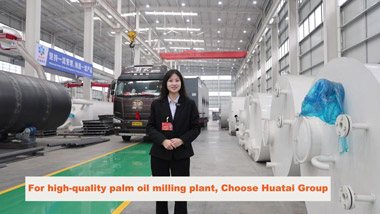
10TPH Palm Fruit Oil Mill Plant Introduction Video
- 2025-12-18 15:27:55
- Source:
Let me introduce the 10 tons per hour palm fruit oil extraction process:
Fresh Fruit Bunch Reception
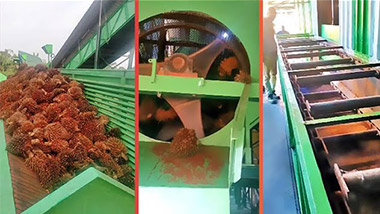
The first step is to receive the fresh fruit bunches. The bunches are picked and transported through a ground pump to the fresh fruit bunch receiving platform. The bunches are unloaded onto this platform, which typically requires an area of 15 meters by 15 meters for a 10-ton capacity. The bunches are then separated, and low-quality ones are removed. A forklift is used to pour the selected bunches into the unloading slope.
Sterilization Process
The unloading slope has four hydraulic doors, each with a capacity of 20 tons. The hydraulic motor and fresh fruit bunch scraper are started to lift the hydraulic door, allowing the bunches to enter the scraper and proceed to the sterilizer station. When the bunches enter the scraper, the top door of the sterilizer tank is opened, and the hopper is placed on the feeding pipe. The unloading scraper on the upper part is opened, and the hydraulic door is closed when full. Note that the hydraulic motor should not run for extended periods as it is prone to overheating.
The steam intake is controlled by PLC and operates automatically. The steam intake valve opens when the tank is full. Fresh fruit bunch feeding generally takes about 70 minutes. When sterilization begins, part of the electromechanical water seal valve must be opened, as the electromechanical ceiling is prone to heating and expansion.
Threshing and Dirty Oil Treatment
After sterilization is complete, the discharge auger is turned on to convey the sterilized material into the ripe fruit bunch feeding hopper. The hydraulic valve is started first, followed by the ripe fruit bunch scraper, which feeds the material uniformly into the thresher.
For dirty oil treatment, wastewater and oil discharged from the sterilizer tank enter the switch tank, then go to the heat exchanger and through the dirty oil trough into the dirty oil pit. From there, it is pumped into the dirty oil storage tank. Wastewater is also pumped into the dirty oil pool and conveyed to the fruit elevator.
Palm Fruit Oil Press Station
At the press station, there is a 10 cubic meter hot water tank on top that can be heated to about 90°C. The digestor receives fruit through the fruit distribution auger. Remaining fruit is conveyed to the fruit elevator through the fruit removal auger. The digestor motor has a voltage of 37 kW with a current limited to 69 amps.
The palm fruit oil pressing machine operates with the pounding tank temperature maintained between 80°C and 90°C. The feed door is slowly opened to allow material to enter the oil press. The oil press hydraulic pump station motor is started, with the current generally running at about 30 amps. The pressure inside the hydraulic pump station is maintained between 30 to 40 MPa.
Crude Palm Fruit Oil Clarification
Crude oil extracted from the oil press enters the sand settling tank through a crude oil trough and remains there for 30 minutes. Settled oil undergoes vibration filtration through the crude oil vibration screen and then enters the crude oil clear oil tank, where it is stored for 15 minutes and heated to 80-90°C. The crude oil pump then transfers it to the vertical clarifying oil tank.
The tank features a steering motor with clear oil skimmers—13 skimmers in total—that skim the clear oil into a clear tank with a capacity of about 5 cubic meters. The clarification time is generally about 6 hours. A dirty oil tank, also 5 cubic meters, collects dirty oil via the dirty oil skimmer.
Crude Palm Fruit Oil Filtering
Clear oil from the clear tank flows through a valve into the oil heating tank and is pumped into a centrifuge by the oil heating tank pump. Oil from the centrifuge goes into the upper vacuum dryer. The vacuum pump of the vacuum dryer is started, and under vacuum conditions, moisture is removed from the oil to meet storage requirements. The finished oil pump then transfers the oil to storage tanks. Large tanks typically have a capacity of 500 tons for 2 weeks or 1,000 tons for 3 weeks.
Oil in the tank is pumped through a dirty oil pump to the upper horizontal separator centrifuge. The centrifuge startup is controlled by PLC. After starting, it is flushed with hot water first, then the valve is opened to allow material to gradually enter. This separates dirty oil, sludge, and water. The processed crude palm oil and refined kernel oil are placed into kernel oil and crude oil tanks, then sent to the oil distribution shed for loading by the oil distribution pump.
Fiber Separation System
The pressed cake is conveyed by a crushing auger to the fiber separation station. The fiber fan sucks the fiber through a cyclone to where the boiler needs it. Fallen nuts are polished by the polishing drum and then enter the elevator to the grating screen. After three-grade separation, they finally enter the nut silo.
When nuts pass through the nut silo, the lower plate is opened and the nuts flow into the crusher. The crushed nut mixtures enter the crushed mixture elevator via the crushed mixture auger and are then conveyed to the first-grade separation column. The shell fan sucks the shell into the area near the boiler room for combustion, and the separated kernel enters the dry kernel silo.
Palm Kernel Processing
The mixture of kernel and shell enters the mud bass separator for separation. Separated kernels enter the kernel elevator, and shells go into the shell auger, which discharges the shell outside the workshop wall. Dry kernel is elevated to the hopper from the lower auger elevator and then enters the palm kernel oil pressing machine. The moisture content of kernel shells should not be less than 7% or greater than 8%.
The first-grade oil pressing produces pressed cake that must be pressed again by the second-grade oil press. The pressed cake is loaded into woven bags and can be used as animal feed. The pressed oil, after slag removal by the slag conveyor, is filtered by the vibration filter and sent to the palm kernel oil temporary storage tank. The palm kernel oil temporary storage tank is heated to about 90-92°C and conveyed to the palm kernel oil storage tank by oil pump.
Support Systems: Water Treatment and Boiler
Raw water is pumped by the raw water pump into the high water tank, then enters the clarified water tank. After chemicals are added by the dosing pump, water goes through the sand filter and is pumped into the high clear water tank by the sand filter pump before entering the workshop.
For the boiler, fiber is fed in by a conveyor chain for combustion. Water is pumped into the boiler by the boiler distribution pump. Steam from the boiler is usually maintained at 7 to 8 kg pressure and fed into the steam distributor through a pressure-reducing valve, then conveyed into the workshop.
Additional Equipment
The oil plant generally requires an air compressor because compressed air must be supplied to various oil pumps at the sterilizing station for purging. A horizontal spiral conveyor handles oil recovery. All recovered oil enters the recovered oil tank and goes through settlement. An oil skimmer on top is adjusted to skim the oil to the dirty oil temporary storage bin, from where it is pumped to the clarifying station.